
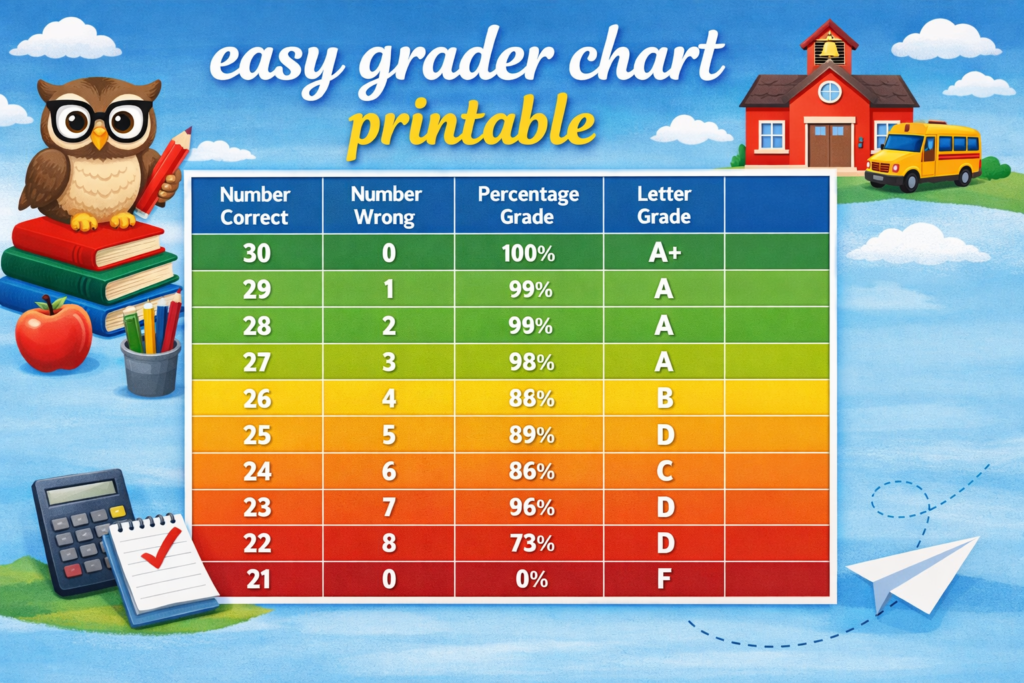
Teachers often face a common challenge after grading quizzes or exams. Calculating percentages for every student can take a surprising amount of time, especially when a class has dozens of papers to review. This is where an easy grader chart printable becomes incredibly helpful. Instead of calculating scores manually, a teacher can simply match the number of correct answers with the total questions and instantly find the percentage grade.
An easy grader chart printable is essentially a reference sheet that converts raw scores into percentages. For example, if a test has 20 questions and a student answers 16 correctly, the chart immediately shows the percentage grade without any calculations. This saves time, reduces mental math errors, and helps teachers return graded work much faster.
Many educators remember the days when grading meant sitting with a calculator and stacks of papers late into the evening. One elementary school teacher once shared how she used to spend nearly two hours calculating scores for weekly quizzes. After discovering printable grading charts, she cut that time down to just thirty minutes. Small tools like these can make a huge difference in daily teaching routines.
Besides saving time, printable grader charts also bring consistency. Since the percentages are pre-calculated, every score follows the same grading standard. Teachers, tutors, and even homeschooling parents use these charts to maintain fair and accurate grading practices.
To better understand the concept of percentage grading, you can also explore resources about percentage calculation which explain how scores are converted into percentages.
Why Teachers Prefer Using an Easy Grader Chart Printable
One of the biggest reasons educators prefer an easy grader chart printable is convenience. Teaching already involves lesson planning, classroom management, student support, and administrative tasks. Any tool that simplifies grading becomes extremely valuable.
Printable grading charts remove the need for constant calculations. When teachers grade papers, they only need to count the number of correct answers and then quickly scan the chart. Within seconds, the percentage score becomes clear.
Another reason teachers appreciate these charts is accuracy. Even the most experienced educators can make mistakes when calculating scores repeatedly. A printable chart removes that risk because the calculations are already prepared in advance.
In addition, these charts are extremely flexible. Teachers can print them in different formats depending on the number of questions on a test. Some charts cover quizzes with 10 questions, while others support exams with 50 or even 100 questions.
For educators interested in modern grading systems, learning about grading in education can provide additional insight into how scores and assessments are structured.
How an Easy Grader Chart Printable Works
At its core, an easy grader chart printable works as a conversion table. Instead of calculating percentages manually, it shows the relationship between correct answers and the final grade.
For example, imagine a quiz that contains 25 questions. After grading the paper, a teacher finds that a student answered 20 questions correctly. Normally, the teacher would divide 20 by 25 and then multiply by 100 to get the percentage.
However, with a printable chart, the process becomes much simpler. The teacher finds the column labeled “25 questions,” then scans down until reaching the row showing “20 correct answers.” The chart instantly shows the corresponding percentage score.
This process removes unnecessary steps and allows teachers to focus more on student feedback instead of repetitive calculations.
Understanding the basics of educational assessment can also help explain how grading tools like these fit into broader teaching practices.
How to Use an Easy Grader Chart Printable Step by Step
Using an easy grader chart printable is straightforward and does not require any special skills or technology. Teachers can begin by printing the chart and keeping it near their grading area.
First, identify the total number of questions on the test. Most printable charts are organized by question count, such as 10, 20, 30, or 50 questions. Once the correct column is located, the teacher simply counts how many answers the student got right.
Next, the teacher scans the chart to match the number of correct answers with the total number of questions. The chart immediately displays the percentage grade. This eliminates the need for calculators or complex formulas.
Many teachers place the chart inside their lesson planner or attach it to a clipboard so it is always accessible. Over time, using the chart becomes second nature, and grading becomes significantly faster.
Some educators even laminate their printable charts so they can reuse them for multiple semesters.
Benefits of Using an Easy Grader Chart Printable
An easy grader chart printable offers several practical advantages for teachers and educators.
One major benefit is time efficiency. Grading becomes a faster process because teachers do not need to perform calculations for every paper. This allows educators to spend more time reviewing student mistakes and providing helpful feedback.
Another advantage is reduced stress. When grading large stacks of assignments, repetitive calculations can become mentally tiring. Printable charts simplify the process and reduce cognitive load.
The charts also promote accuracy. Since percentages are already calculated, there is less chance of human error. This ensures fair grading for every student.
Teachers working in busy classrooms often appreciate tools that streamline routine tasks. A simple printable chart may seem small, but it can significantly improve workflow and productivity.
Where to Find an Easy Grader Chart Printable
Finding an easy grader chart printable online is quite easy. Many educational websites offer free printable versions that teachers can download instantly.
Some charts are designed for specific classroom needs. For example, elementary school teachers may prefer charts that support quizzes with fewer questions, while high school educators might use charts for larger exams.
Educational resource platforms often provide printable grading charts along with other useful teaching materials. Teachers can also customize their own charts using spreadsheet tools or grading templates.
In many cases, these charts are shared within teacher communities where educators exchange classroom resources and teaching tips.
Tips for Making the Most of an Easy Grader Chart Printable
Teachers who regularly use an easy grader chart printable often develop small habits that make grading even smoother. One common tip is to keep multiple copies in different places, such as a desk drawer, planner, or grading folder.
Another helpful strategy is highlighting frequently used rows on the chart. For example, if quizzes often contain 20 questions, teachers may highlight that section for quicker reference.
Some educators also combine printable charts with digital grading systems. While many schools use electronic gradebooks, the printable chart remains useful during the initial grading process.
Over time, these small efficiencies add up and make the entire grading workflow easier to manage.
Conclusion
An easy grader chart printable may appear simple, but it is a powerful tool for educators who want to grade papers quickly and accurately. By removing the need for constant calculations, printable grading charts save time, reduce errors, and make the grading process more efficient.
Teachers already juggle many responsibilities each day, from preparing lessons to supporting students. Tools like printable grading charts help lighten that workload and allow educators to focus on what truly matters: helping students learn and grow.
Whether used in traditional classrooms, tutoring sessions, or homeschooling environments, an easy grader chart remains one of the most practical resources for simplifying test score calculations.