
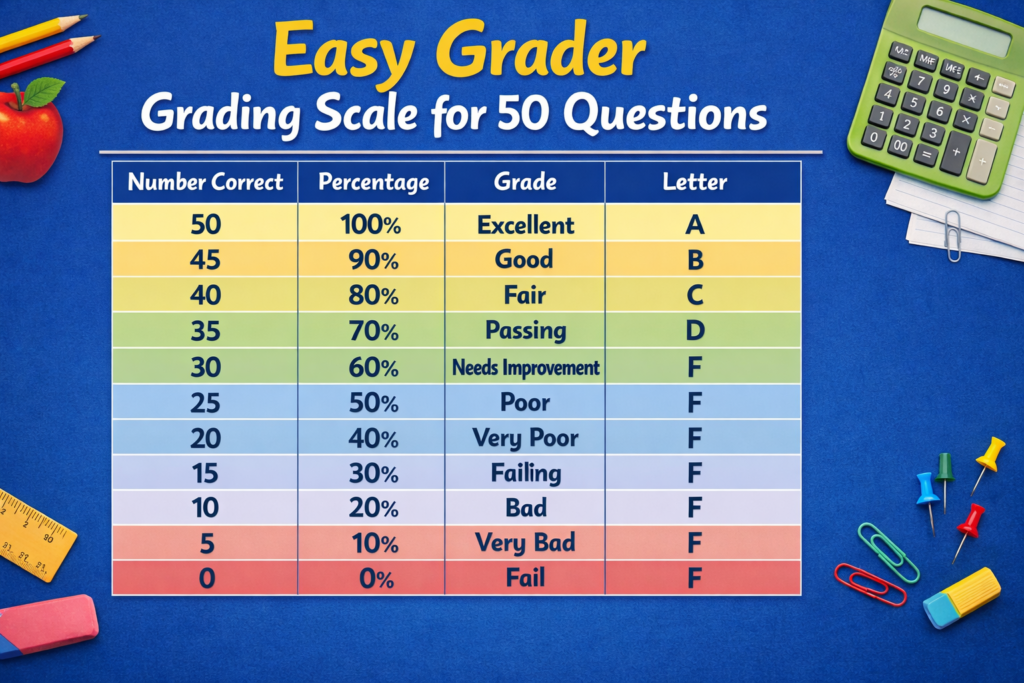
When a teacher finishes checking a test, one of the first questions that comes to mind is simple: how do you turn the number of correct answers into a fair grade without wasting time? That is exactly where the easy grader grading scale for 50 questions becomes useful. It gives a quick and clear way to convert raw scores into percentages and grades, so the whole grading process feels less stressful and far more organized. For teachers handling a full stack of papers, for homeschool parents checking weekly quizzes, or even for students trying to estimate results before report cards come out, this method saves time and reduces confusion.
A lot of people remember the old classroom moment when a teacher would sit with a paper grade chart or a rotating grading wheel, quickly finding the percentage for every score. It felt almost magical. Instead of reaching for a calculator every single time, they used a simple system that instantly showed what 48 out of 50 or 37 out of 50 really meant. That is the beauty of an easy grader grading scale for 50 questions. It takes something that could feel repetitive and turns it into a quick routine.
Easy Grader Grading Scale for 50 Questions and Why It Matters
The easy grader grading scale for 50 questions matters because 50-question tests are extremely common in schools, training programs, online quizzes, and practice exams. Since 50 is a clean number, it is easier to turn scores into percentages than with many other test lengths. Even so, people still make mistakes when grading in a hurry. A grading scale helps avoid those errors and makes scoring more consistent.
In simple terms, an easy grader is a tool that shows how many answers a student got right, what percentage that score equals, and often what letter grade it may represent. If a student answers 45 questions correctly out of 50, the percentage is 90 percent. If they answer 40 correctly, that becomes 80 percent. This sounds easy enough, but when you are grading many papers at once, small math slips can happen. That is why teachers often rely on grading charts, online calculators, or traditional grading wheels such as the ones associated with the concept of an <a href=”https://en.wikipedia.org/wiki/Grading_in_education” target=”_blank” rel=”dofollow”>grading system in education</a>.
Just imagine a teacher checking papers late in the evening after a long school day. The difference between 43 and 44 correct answers may seem small, but it can affect a final grade. Using the easy grader grading scale for 50 questions helps maintain fairness because each score is matched to the correct percentage right away. As a result, students get more accurate results and teachers feel more confident in their grading.
Easy Grader Grading Scale for 50 Questions Chart Explained
When people search for the easy grader grading scale for 50 questions, they are often looking for a simple chart that tells them exactly what each score means. The idea is straightforward. You start with the number of correct answers, divide it by 50, and then multiply by 100 to get the percentage. Since each question on a 50-question test is worth 2 percent, the scale becomes very easy to understand.
Easy Grader Grading Scale for 50 Questions Percentage Breakdown
Here is the basic logic in paragraph form. If a student gets 50 out of 50, the score is 100 percent. If they miss one question and get 49 correct, the score becomes 98 percent. If they get 48 correct, the percentage is 96 percent. Every missed question lowers the total by 2 percent. Because of that, the scale is neat, predictable, and easy to follow. A score of 45 out of 50 equals 90 percent, 40 out of 50 equals 80 percent, 35 out of 50 equals 70 percent, and 25 out of 50 equals 50 percent.
This pattern makes the test score percentage easy to estimate even without a tool. That is one reason why 50-question tests are so popular. Teachers can review them quickly, and students can often predict their own results with reasonable accuracy. For more background on how percentages work, a clear reference can be found through <a href=”https://www.mathsisfun.com/percentage.html” target=”_blank” rel=”dofollow”>percentage basics</a>.
Easy Grader Grading Scale for 50 Questions and Letter Grades
Many schools also connect percentages to letter grades. Although grading policies vary by school, district, and country, a common system works like this in everyday practice. Scores from 90 to 100 percent often fall into the A range. Scores from 80 to 89 percent are usually B range. Scores from 70 to 79 percent often become C range. Scores from 60 to 69 percent may be D range, and anything below that is commonly considered failing. Since systems differ, it helps to compare results with your own school’s official policy or a trusted academic resource such as <a href=”https://www.britannica.com/topic/grading-system” target=”_blank” rel=”dofollow”>grading system references</a>.
So if a student scores 46 out of 50, that becomes 92 percent, which is often an A. If another student scores 39 out of 50, that becomes 78 percent, which may be a C or sometimes a high C depending on the school. This is where the letter grade conversion part of the process becomes useful.
Easy Grader Grading Scale for 50 Questions in Real Classroom Use
The easy grader grading scale for 50 questions is not just about math. It is also about making classroom life smoother. In real teaching situations, speed matters, but fairness matters even more. A teacher may have 30 quizzes from one class, 25 from another, and several assignments still waiting. In that kind of routine, saving a few seconds per paper adds up quickly.
There is also a practical side for students and parents. A student who knows they got 42 answers right can immediately understand that the score is 84 percent. That helps them see where they stand without waiting for a full report. Parents can also use the same scale at home when checking practice worksheets or mock exams. In homeschooling especially, tools like an <a href=”https://www.calculatorsoup.com/calculators/statistics/grade-calculator.php” target=”_blank” rel=”dofollow”>grade calculator</a> can make daily assessment much easier.
Anecdotally, many teachers say grading gets much less frustrating once they start using a fixed scale. One middle school teacher described how she used to double-check every percentage on a calculator because she was afraid of making a mistake. Later, she switched to a quick grader chart for common test lengths like 20, 25, 50, and 100 questions. That one change saved her a surprising amount of time each week. More importantly, she felt more relaxed because the system was consistent.
Easy Grader Grading Scale for 50 Questions Step by Step
Even though the article is in paragraph form, the process itself still works best as a simple sequence explained naturally. First, count the number of correct answers on the test. Second, compare that number against the total number of questions, which in this case is 50. Third, convert the score into a percentage. Since every question is worth 2 percent, you can multiply the number of correct answers by 2. Fourth, match that percentage to your school’s grading scale. That final step tells you whether the score fits into an A, B, C, or another grade category.
Easy Grader Grading Scale for 50 Questions Without a Calculator
One reason people love the easy grader grading scale for 50 questions is that you can do the math in your head. A student who gets 41 correct answers has a score of 82 percent. A student who gets 38 correct answers has 76 percent. A student who gets 27 correct answers has 54 percent. Since each answer is worth exactly 2 percent, mental calculation becomes very manageable.
This also makes the grading chart for teachers especially useful during fast review sessions. Teachers can look at a raw score and almost instantly know the percentage. That means less time spent on calculation and more time spent on feedback, correction, and student support.
Easy Grader Grading Scale for 50 Questions Using Online Tools
Although the math is simple, many people still prefer digital support. Online easy grader tools can instantly display correct answers, wrong answers, percentage scores, and in some cases letter grades too. These tools are especially helpful for teachers who want quick consistency across many assignments. They can also help students double-check practice results before an exam.
For example, someone preparing for a multiple-choice exam may use an <a href=”https://www.omnicalculator.com/other/test-grade” target=”_blank” rel=”dofollow”>online test grade calculator</a> to estimate performance. That is a practical way to understand how many mistakes they can afford while still reaching a target grade.
Easy Grader Grading Scale for 50 Questions and Test Score Accuracy
Accuracy is one of the biggest reasons this scale is important. A rushed grading session can lead to tiny mistakes that have real consequences. If a teacher accidentally records 44 correct answers as 86 percent instead of 88 percent, that may affect how the student and parents view the result. Over time, repeated small errors can create larger concerns.
The easy grader grading scale for 50 questions reduces that risk because the relationship between raw score and percentage stays constant. Every right answer adds exactly 2 percent. That clarity helps avoid confusion. It also supports better communication. When students ask how a grade was calculated, the teacher can explain it in one sentence. That simple transparency matters.
There is also a broader educational benefit here. Clear grading can improve trust in the classroom. Students feel more comfortable when they understand how their performance is measured. Parents also appreciate straightforward systems, especially when reviewing report cards or progress checks at home.
Easy Grader Grading Scale for 50 Questions for Students and Parents
Students often search for the easy grader grading scale for 50 questions because they want a quick estimate of their exam results. That is completely understandable. Waiting for grades can be stressful. A clear grading scale gives them an immediate sense of how well they performed.
For parents, the same scale can be helpful during homework review, tutoring, and exam preparation. If a child completes a 50-question practice test at home and gets 36 correct, the parent can quickly see that the score is 72 percent. That may open a useful conversation about which topics need more practice. In that way, grading becomes more than a number. It becomes a tool for learning improvement.
A parent once shared that her son used to feel discouraged after practice tests because he only looked at how many questions he missed. When she started converting the scores using a simple easy grader system, he began focusing on percentages and progress instead. Suddenly, going from 64 percent to 74 percent felt like visible improvement. That small change in perspective made a big difference in motivation.
Easy Grader Grading Scale for 50 Questions and Semantic Understanding of Scores
The easy grader grading scale for 50 questions also helps people understand several related concepts that often appear in education. These include test score calculator, percentage calculator for exams, grading rubric, score conversion, exam grading scale, and academic performance measurement. While these terms may sound technical, they all connect to one simple goal: making scores easier to understand.
Easy Grader Grading Scale for 50 Questions vs Manual Grading
Manual grading without a scale can work, but it is slower and more error-prone. A teacher may still count answers correctly, yet pause each time to calculate the final percentage. With an easy grader chart or tool, that extra mental step is removed. The score becomes instantly visible. This is why so many teachers prefer using dedicated resources or printable charts.
At the same time, an easy grader does not replace teacher judgment. It only supports the scoring side. Teachers still decide the difficulty of the test, the weighting of assignments, and the academic meaning of the results. In other words, the grader helps with speed and consistency, while the teacher remains in control of the bigger learning picture.
Easy Grader Grading Scale for 50 Questions and Common Mistakes
One common mistake is forgetting that every question in a 50-question test is worth 2 percent. Another is mixing raw scores with percentages. For example, someone may see 35 correct answers and think that sounds strong, but the actual percentage is 70 percent. Depending on the grading policy, that could be average rather than excellent. Another mistake is assuming all schools use the same letter grade boundaries. Some schools have plus and minus systems, while others do not.
That is why it helps to use trusted educational references and official school policies when interpreting scores. A general explanation of scoring and evaluation can also be found through resources on <a href=”https://www.edutopia.org/article/grading-practices-and-learning” target=”_blank” rel=”dofollow”>grading practices and learning</a>.
Easy Grader Grading Scale for 50 Questions as a Long-Term Academic Tool
Over time, the easy grader grading scale for 50 questions becomes more than a quick chart. It turns into a habit that supports better organization. Teachers can grade faster, students can track progress more clearly, and parents can understand results without extra guesswork. In many ways, it is one of those small tools that quietly makes education easier.
It also encourages better communication. When everyone understands what 47 out of 50 means, conversations become more productive. Instead of arguing over the result, people can focus on what the student learned, where mistakes happened, and how to improve next time. That is where the real value lies.
Conclusion
The easy grader grading scale for 50 questions is a simple but highly practical way to convert raw scores into percentages and letter grades. Because each question is worth 2 percent, the scale is easy to understand, quick to apply, and reliable for classrooms, homeschooling, tutoring, and self-assessment. It reduces grading errors, saves time, and makes test results easier for everyone to understand.
Whether you are a teacher grading a stack of quizzes, a parent checking practice work, or a student estimating exam performance, this scale offers a clear path forward. Sometimes the best tools are not flashy at all. They are just dependable, easy to use, and helpful exactly when you need them. That is exactly why the easy grader grading scale for 50 questions remains such a useful resource.