
If you have ever sat with a stack of test papers and a red pen, you already know how time consuming grading can be. This is exactly where the easy grader grading scale for 50 questions becomes a lifesaver. Whether you are a teacher, tutor, homeschooling parent, or even a student checking practice work, understanding how this grading method works can save time and reduce mistakes.
In this guide, you will learn what an easy grader is, how the grading scale works for a 50 question test, how to calculate percentages quickly, and how to avoid common grading errors. By the end, you will feel confident using this system in a smooth and organized way.
What Is Easy Grader Grading Scale for 50 Questions and Why It Matters
The easy grader grading scale for 50 questions is a straightforward method used to convert the number of correct answers into a percentage score. Instead of manually calculating each percentage using long division, this system simplifies the process.
For a 50 question test, each question is worth 2 percent. That simple fact changes everything. Because 100 divided by 50 equals 2, you can quickly determine a student’s score by multiplying the number of correct answers by 2.
For example, if a student answers 42 questions correctly, you simply calculate 42 multiplied by 2. The final score is 84 percent.
I once worked with a teacher who used to carry a calculator everywhere during exam season. She would carefully divide each score and double check every result. After switching to an easy grading scale for 50 questions, she finished grading in half the time and felt far less stressed.
This method is not just about speed. It also improves grading accuracy and keeps results consistent.
How to Use Easy Grader Grading Scale for 50 Questions Step by Step
Understanding the easy grader grading scale for 50 questions becomes effortless once you follow a simple process.
First, count the total number of correct answers. Accuracy at this stage is important. Take your time and double check.
Second, multiply the correct answers by 2. Since each question carries equal weight, this gives you the percentage instantly.
Third, record the final percentage score clearly. Some teachers also convert percentages into letter grades depending on their grading system.
For example, imagine a student scores 37 out of 50. Multiply 37 by 2. The result is 74 percent. If your grading scale considers 70 to 79 percent as a C grade, then that would be the assigned letter grade.
The beauty of this method is its simplicity. There is no complex formula involved. You only need basic multiplication.
Understanding the Grading Breakdown for 50 Questions
When using the easy grader grading scale for 50 questions, it helps to understand how different scores translate into percentages.
Because each question equals 2 percent, missing just one question reduces the final score by 2 percent. Missing five questions lowers the score by 10 percent.
For example, if a student gets 45 correct answers, that means they missed five questions. Multiply 45 by 2 and the score becomes 90 percent.
This structure makes it easy to explain results to students. Instead of saying they dropped 10 percent, you can say they missed five questions. It becomes more clear and less intimidating.
Students often feel less anxious when they understand how grading works. Transparency builds trust in the classroom.
Why Teachers Prefer Easy Grader for 50 Question Tests
There are several reasons educators choose the easy grader grading scale for 50 questions over traditional percentage calculations.
First, it saves time. When grading multiple classes, even a few seconds saved per paper adds up quickly.
Second, it reduces errors. Manual percentage calculations can lead to small mistakes that affect final grades. Since the math here is consistent and simple, errors are less likely.
Third, it keeps grading fair and standardized. Every student’s test is calculated using the same method.
I remember a colleague who once miscalculated several test scores because of a small calculator mistake. It caused confusion and required rechecking every paper. After adopting the easy grading scale method, those issues disappeared.
Consistency is a key part of professional grading.
Easy Grader Grading Scale for 50 Questions in Digital Tools
Today, many teachers use online grading tools or apps to speed up their workflow. However, even when using technology, understanding the easy grader grading scale for 50 questions is essential.
If a digital platform fails or you need to calculate scores manually, knowing the method gives you confidence. You are not dependent on software.
Many online easy grader calculators automatically convert raw scores into percentages. However, the logic remains the same. They are simply multiplying correct answers by 2.
Having that basic knowledge keeps you in control.
Common Mistakes When Using Easy Grader Grading Scale for 50 Questions
Even though the system is simple, small mistakes can still happen.
One common issue is counting incorrect answers instead of correct ones. Always count correct responses first. That keeps your multiplication accurate.
Another mistake is forgetting that this scale works specifically for 50 questions. If your test has 40 or 60 questions, the percentage value per question changes.
For example, in a 40 question test, each question is worth 2.5 percent. In a 25 question test, each question equals 4 percent.
So always confirm the total number of questions before applying the grading scale.
How Easy Grader Grading Scale for 50 Questions Helps Students
Students benefit from understanding the easy grader grading scale for 50 questions just as much as teachers do.
When students know each question is worth 2 percent, they can estimate their own scores immediately after finishing the test. This builds awareness and accountability.
For example, if a student believes they missed about 8 questions, they can quickly calculate that they likely scored around 84 percent.
This self evaluation encourages responsibility and better exam preparation.
I once shared this method with a group of high school students before a major exam. After the test, instead of panicking, they calmly estimated their scores. It reduced stress and increased confidence.
Knowledge creates clarity.
Easy Grader Grading Scale for 50 Questions and Letter Grade Conversion
Many institutions convert percentage scores into letter grades. While grading systems differ, a common structure looks like this in paragraph explanation.
A score between 90 and 100 percent is often considered an A grade. Scores between 80 and 89 percent typically represent a B grade. Scores between 70 and 79 percent are usually marked as C. Scores between 60 and 69 percent may fall into D range, while anything below 60 percent is considered failing in many systems.
Using the easy grader grading scale for 50 questions, converting to letter grades becomes simple because percentages are calculated instantly.
For instance, if a student answers 48 questions correctly, multiply 48 by 2 to get 96 percent. That would clearly fall into the A range in most grading systems.
Tips to Make Grading Faster and More Organized
When using the easy grader grading scale for 50 questions, organization plays a major role.
Keep answer keys clearly marked. Grade one section at a time rather than jumping around the paper. Use a consistent marking style to avoid confusion.
Some teachers prefer grading all question one responses across every paper before moving to question two. Others grade one paper fully before moving to the next. Find the system that works best for you.
The key is consistency.
Also, take short breaks during long grading sessions. Fatigue can lead to counting errors.
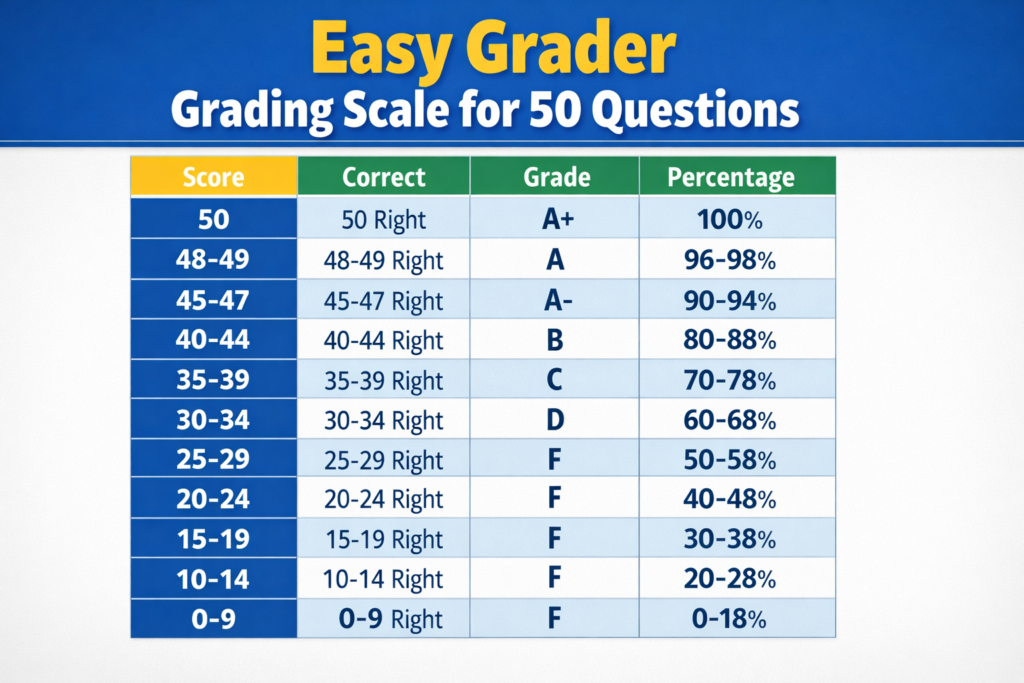
Visual Reference for Easy Grader Grading Scale for 50 Questions
A visual chart showing how scores convert into percentages can make grading even faster. Many teachers print and keep one near their desk for quick reference.
Seeing the full scale laid out clearly reduces the need for repeated calculations.
Final Thoughts on Easy Grader Grading Scale for 50 Questions
The easy grader grading scale for 50 questions is simple, practical, and highly efficient. Because each question equals 2 percent, calculating final scores becomes quick and accurate. This method saves time, reduces stress, and creates consistent results.
Whether you are grading weekly quizzes or final exams, mastering this grading scale helps you stay organized and confident. Moreover, when students understand how their scores are calculated, they feel more in control of their learning.
At the end of the day, grading should support learning rather than create confusion. With the right system in place, the process becomes smoother for everyone involved.
If you regularly work with 50 question tests, adopting this method will make your grading routine faster, clearer, and far less overwhelming.