
If you have ever sat with a pile of papers to grade, you already know how tiring and time-consuming it can be. I remember a teacher once joking that grading exams felt longer than taking them. That is exactly where the easy grader grading scale for 30 questions becomes a lifesaver. It simplifies the entire grading process and removes the stress of calculating percentages again and again.
The idea behind an easy grader is simple. Instead of manually dividing scores and converting them into percentages, you use a pre-calculated system. This helps teachers, tutors, and even students quickly understand performance without wasting time. More importantly, it reduces human error, which often happens when you’re tired or rushing.
In this guide, we will walk through everything you need to know about the easy grader grading scale for 30 questions, how it works, and how you can use it effectively in real situations.
Understanding the Easy Grader Grading Scale for 30 Questions
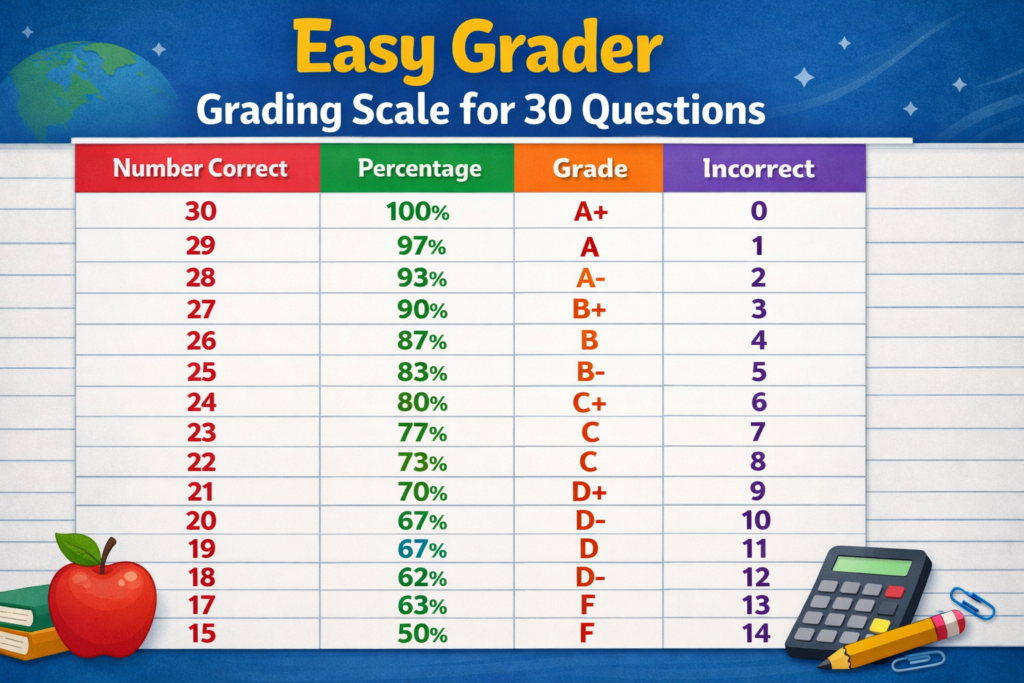
The easy grader grading scale for 30 questions is essentially a conversion system. It shows how many correct answers out of 30 translate into percentages and grades. Instead of calculating each score manually, you just match the number of correct answers with the corresponding percentage.
For example, if a student gets 27 out of 30 correct, you do not need to calculate anything. The scale already tells you that 27 correct answers equal 90 percent. This makes grading smooth and consistent.
What makes this system even more useful is that it keeps grading fair. When every student is graded using the same scale, there is no confusion or inconsistency. Over time, this builds trust between teachers and students.
Why Teachers Prefer Easy Grader Grading Scale for 30 Questions
One of the main reasons teachers love the easy grader grading scale for 30 questions is because it saves time. Imagine grading 100 papers. Without a system, you would calculate each score individually. With an easy grader, you simply look up the score and move on.
Another reason is accuracy. Even experienced teachers can make small mistakes when calculating percentages repeatedly. The easy grader removes that risk completely.
There is also a psychological benefit. When grading becomes faster and easier, teachers feel less overwhelmed. This allows them to focus more on giving feedback rather than just calculating numbers.
I once spoke to a teacher who switched to an easy grader after years of manual grading. She said it felt like “getting hours of her life back.” That is the real value of using a system like this.
How to Use Easy Grader Grading Scale for 30 Questions Step by Step
Using the easy grader grading scale for 30 questions is very straightforward, even if you have never used one before.
First, count the number of correct answers on the test. Let’s say a student answered 24 questions correctly out of 30.
Next, refer to the grading scale. You find the number 24 and look at its corresponding percentage. In this case, 24 out of 30 equals 80 percent.
Finally, assign the grade based on your grading criteria. If your system says 80 percent is a B grade, then the student gets a B.
This process takes only a few seconds, which is why so many educators rely on it.
Easy Grader Grading Scale for 30 Questions Explained with Real Examples
Let’s make things even clearer with a simple example.
Imagine you are grading a quiz in a classroom. One student gets 30 out of 30. That is obviously 100 percent. Another student gets 15 correct answers. Instead of calculating, you check the scale and see that 15 out of 30 equals 50 percent.
Now think about grading 50 such papers. Without the easy grader grading scale for 30 questions, you would spend a lot of time calculating each one. With the scale, you move quickly from one paper to another.
This is especially helpful during exam season when teachers already have a heavy workload.
Secondary Keywords: Benefits of Using Easy Grader Calculator in Daily Teaching
When you combine the easy grader grading scale for 30 questions with an easy grader calculator, things become even more efficient. A calculator automates the process completely. You just input the total number of questions and the number of wrong answers, and it instantly shows the grade.
The biggest benefit here is speed. In a busy school day, every minute counts. Teachers can grade tests during short breaks or even between classes.
Another advantage is flexibility. You can adjust the grading scale based on your requirements. Some teachers prefer stricter grading, while others use a more relaxed system. An easy grader calculator supports both.
Secondary Keywords: How to Convert Test Scores into Percentages Easily
Converting test scores into percentages is one of the most common tasks in teaching. The easy grader grading scale for 30 questions makes this process almost effortless.
Instead of using formulas like dividing the score by total questions and multiplying by 100, you rely on the pre-made scale. This removes the need for calculations entirely.
For example, if a student scores 21 out of 30, the scale directly shows 70 percent. This consistency ensures that every student is graded fairly.
Secondary Keywords: Grading Scale for Teachers and Classroom Efficiency
A well-defined grading system is essential for classroom management. The easy grader grading scale for 30 questions helps maintain that consistency.
When students understand how their scores are calculated, they feel more confident about the grading process. This transparency improves trust and reduces complaints.
Moreover, teachers can use the saved time to focus on lesson planning, student engagement, and feedback. Instead of being stuck with calculations, they can invest energy in improving the learning experience.
Secondary Keywords: Tips for Accurate and Fast Paper Checking
Accuracy and speed go hand in hand when using the easy grader grading scale for 30 questions. However, there are a few simple habits that can make the process even better.
Always double-check the total number of questions before grading. A small mistake here can affect the entire result.
Also, keep your grading scale easily accessible. Whether it is printed or digital, having it nearby saves time.
Another helpful tip is to grade in batches. This keeps your focus steady and reduces the chances of mistakes.
Common Mistakes to Avoid When Using Easy Grader
Even though the easy grader grading scale for 30 questions is simple, there are a few mistakes to watch out for.
One common mistake is using the wrong total number of questions. If the test has 30 questions but you accidentally use a 25-question scale, the results will be incorrect.
Another mistake is rushing through the process. While the system is fast, taking a moment to verify scores ensures accuracy.
Finally, avoid relying completely on numbers. While grades are important, feedback is equally valuable for student growth.
Final Thoughts on Easy Grader Grading Scale for 30 Questions
The easy grader grading scale for 30 questions is more than just a tool. It is a practical solution to one of the most time-consuming tasks in teaching.
By simplifying calculations, improving accuracy, and saving time, it allows teachers to focus on what truly matters. That is helping students learn and grow.
Whether you are a new teacher or someone with years of experience, adopting this system can make a noticeable difference in your daily routine.
And honestly, once you start using it, going back to manual grading feels almost impossible.